 Italy
Outcome summary
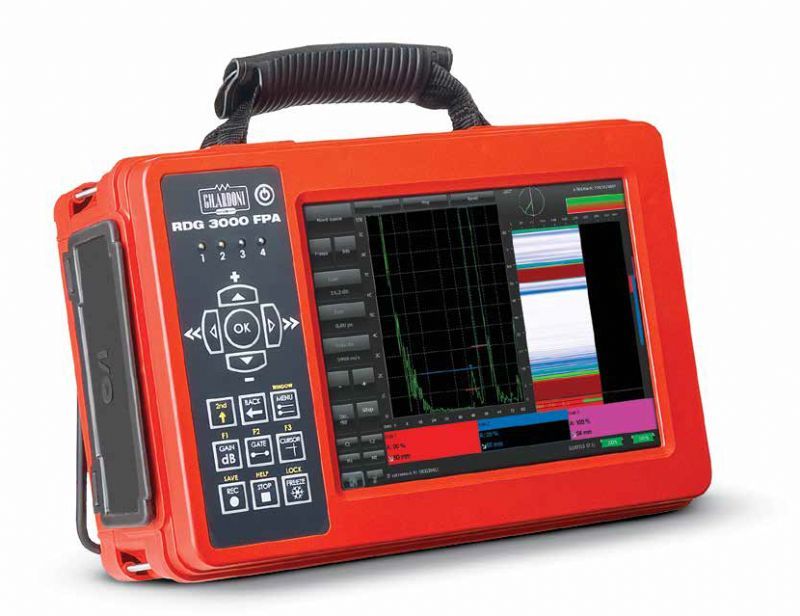
We designed the software of Gilardoni's RDG-2000, RDG-2500 and RDG-2500S ultrasonic flaw detectors: the signal, the screen the inspector reads, the correction curves and the stored record.
Starting situation
Gilardoni is an Italian maker of X-ray and ultrasonic equipment for non-destructive testing. The RDG instruments are portable ultrasonic flaw detectors: inspectors use them to find cracks and defects inside metal parts and welds without damaging them. An instrument like this is only as good as its software: acquiring the signal, showing it clearly and producing a record the inspector can trust.
The system
- The signal path: acquiring the ultrasonic signal and showing it on the screen.
- The amplitude-correction curves used in the field: DAC, TGC and AVG/ADA, with customisable DAC curves on four selectable levels.
- The internal data logger and the stored record.
- The user interface: a dedicated keyboard and a screen that flips for left- and right-handed use.
Implementation
The instruments are described on Gilardoni's product page: a 7-inch transflective colour display readable in difficult light, 1.6 kg with the Li-Ion battery, 14 hours of autonomy and IP 67 protection against water and oil. The NDA that covered this work ran for ten years and expired in 2021, so we can now name the instruments.
Results and evidence
The software is the one running in Gilardoni's RDG-2000, RDG-2500 and RDG-2500S.